If you’ve seen Big Boy in action — arriving at a show, or lifting and shifting around the yard — you’ll have noticed he doesn’t need a crane, a forklift, or four blokes with a strong back to load and unload. He just… does it himself. That’s DROPS.
So what actually is DROPS?
DROPS stands for Demountable Rack Offload and Pickup System. It’s a hooklift system originally developed for the British Army in the 1980s, designed to solve a very unglamorous but very real problem: getting supplies off a truck and onto the ground (or vice versa) as fast as possible, without waiting around for handling equipment that might not even be there.
The idea was simple but genuinely clever — build a truck that carries its own loading crew, so to speak. A hydraulic arm mounted behind the cab reaches back, hooks onto a flatrack or ISO container, and winches it up onto the chassis. Reverse the process and the load is set down on the ground just as easily. The whole cycle takes a couple of minutes, no external kit required.
It was born out of Cold War logistics planning for the British Army of the Rhine, when planners realised that fixed-body trucks unloaded by forklift simply couldn’t keep pace with a fast-moving battlefield. DROPS-equipped vehicles like the Leyland DAF and Foden entered service into the early 1990s and ended up proving just as useful in operations well outside the deserts and depots they were originally built for.
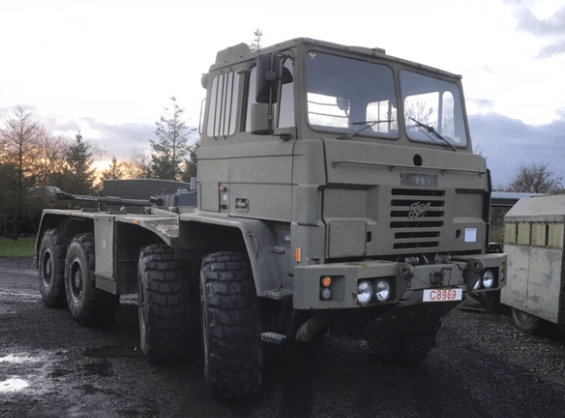
Why it matters on a truck like Big Boy
Big Boy’s hookloader is the same fundamental concept — a heavy-duty demountable system fitted to an 8×8 chassis built for serious cross-country mobility. With a carrying capacity in the region of 20 tonnes, he can pick up a loaded flatrack, container, or specialist body straight off the ground and be moving again in minutes, with no dependency on a crane or loading dock.
It’s this combination — go-anywhere 8×8 mobility plus self-sufficient loading — that made trucks like this so valuable for military logistics, and it’s exactly the same reason the hookloader remains Big Boy’s headline feature today. Whether it’s swapping bodies, shifting materials around a build site (long-time followers will remember the barn-raising footage), or just showing off at a show, the hookloader is the bit that gets people asking questions.
The Race2Recovery connection
This is where the hookloader stopped being a nice-to-have and became genuinely essential. Race2Recovery’s crew included mechanics who were amputees, and a standard T5-configuration support truck mounts its workshop body high up at the back — great for ground clearance, not so great if you’re climbing in and out on prosthetics multiple times a day, under time pressure, out in the desert.
The team that built the back body designed it specifically to solve that problem. Instead of a fixed high-mounted body, the workshop pod could be set down at ground level whenever it was needed. No climbing, no awkward transfers — just quick, level access to the tools and kit required to keep the Wildcats running. It’s a small detail on paper, but out on rally it’s the difference between a five-minute job and a fifteen-minute one, repeated over and over across a stage.
The short version
- DROPS = Demountable Rack Offload and Pickup System
- Originated with the British Army in the 1980s/90s for rapid resupply
- Hydraulic arm hooks and winches a flatrack/container on or off the chassis
- No external handling equipment needed — load or unload solo in a couple of minutes
- Big Boy’s hookloader runs on the same principle, giving him serious self-loading capability to go with his 8×8 mobility
Next time you see Big Boy quietly picking up a flatrack like it’s nothing, you’ll know there’s a proper bit of military engineering history behind that party trick.


Leave a Reply