Before Big Boy ever turned a wheel in support of a Dakar campaign, he was born into one of the most demanding vehicle programmes of the Cold War. To understand what makes the MAN KAT1 8×8 such a capable base for a truck like Big Boy, it’s worth going back to where the design came from — and why it was built the way it was.
A Cold War Problem: Keeping Up With Tanks
The story starts in the early 1960s. West German military planners were drawing up requirements for a new generation of army vehicles, and the brief was demanding: a family of trucks across the 4 to 10 tonne payload range, able to cross severe terrain while keeping pace with main battle tanks. Nothing off the shelf could do that job, so no single manufacturer took it on alone. Instead, a joint venture was formed under MAN’s leadership, bringing in Klöckner-Humboldt-Deutz, Rheinstahl-Henschel, Krupp, and Büssing (later absorbed into MAN outright in 1971).
The result of that collaboration was a truck family the Bundeswehr classified as Kategorie 1 — KAT1 for short. Officially, these trucks were “mil gl”: militarisiert geländegängig, or “militarised, cross-country capable.” Unofficially, troops just called them the “5-, 7-, 10-, 15-Tonner” after their payload class, and “Tonner” became Bundeswehr slang for “truck” more generally.
The 8×8 Comes First
It’s a detail that surprises people who assume the smaller 4×4 and 6×6 KAT1s came first: the 8×8 configuration — Big Boy’s configuration — was actually the first KAT1 model to enter production. The procurement treaty between the Bundeswehr and MAN was signed on 4 December 1975, and deliveries of the 8×8 began in 1976, with the 6×6 and 4×4 variants following in 1977.
By the time the initial production run wound down in the early 1980s, over 8,600 KAT1s had been delivered to the Bundeswehr across all configurations.
Built to a Brief, Not a Budget
Every KAT1, regardless of axle count, shares the same underlying philosophy: a torsionally rigid box-section chassis frame, with rigid hub-reduction axles sprung on coil springs and shock absorbers rather than conventional leaf springs. That gives the long-travel, high-articulation ride that makes these trucks so capable off-road.
One particularly deliberate design choice: the engine sits behind the driver’s compartment rather than underneath it, keeping the overall vehicle height below 2.9 metres. That wasn’t just about ground clearance — it meant KAT1s could still be transported on standard rail flatcars, a genuinely Cold War logistics requirement (moving armour and support vehicles by rail across Europe at speed).
The A1 Generation
The KAT1 didn’t stand still. From 1988, an upgraded A1 generation introduced improved engines, a revised chassis and cab, and — notably for the 8×8 — a new 15,000kg payload class as a direct replacement for the original 10,000kg trucks. The A1 generation also marked a shift toward using more standard commercial parts, drawing driveline components from MAN’s F90 heavy truck range introduced in 1986. Around 1,100 A1 models were built for the Bundeswehr.
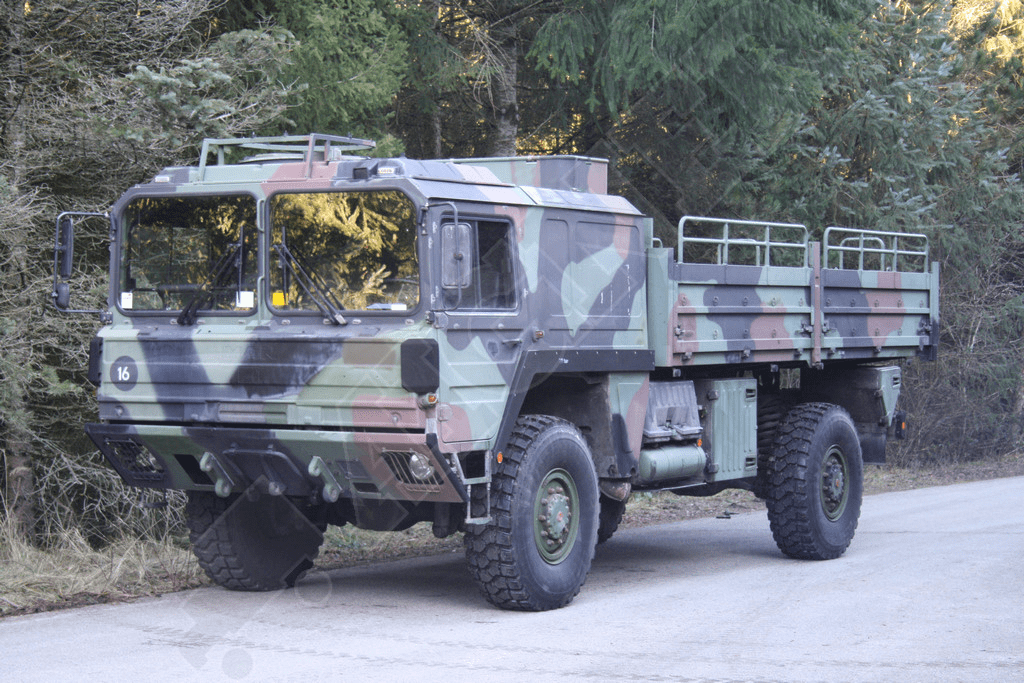
Given Big Boy’s ZF 16S251 gearbox and WSK torque converter/retarder setup, this A1-era driveline is exactly the specification he carries — a truck built not just to the original 1970s KAT1 brief, but to the refined, more powerful standard that followed it.
From Active Service to Second Life
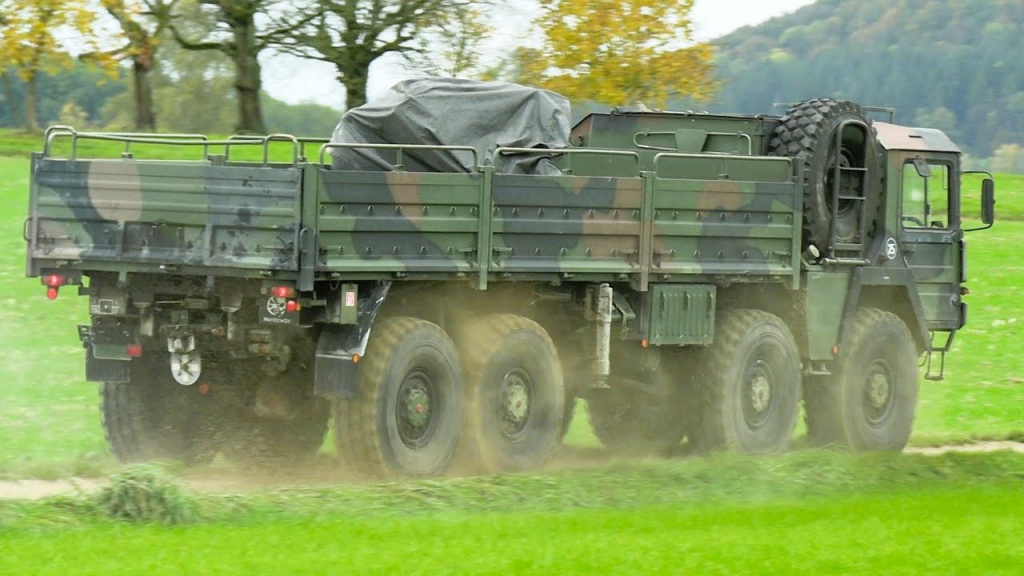
KAT1s underwent a full overhaul in the mid-1990s specifically to extend their service life by another decade — which is a large part of why so many well-maintained examples eventually found their way onto the civilian market rather than being scrapped outright. The broader KAT1 lineage itself kept evolving long after, into the MAN SX range, which stayed in production until as recently as 2019.
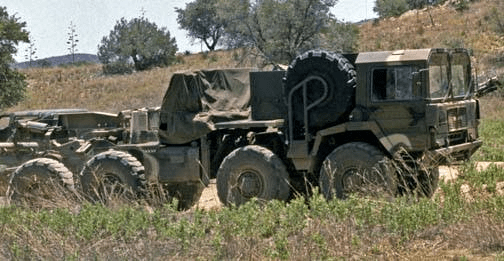
It’s also worth noting the KAT1 8×8’s reach beyond Germany: the US Army and US Air Force operated their own derivatives of the design, and one variant — the M1001 — served as the prime mover for the Pershing II nuclear missile system. This was never a niche, low-volume design; it was a Cold War logistics backbone.
Why It Matters for Big Boy
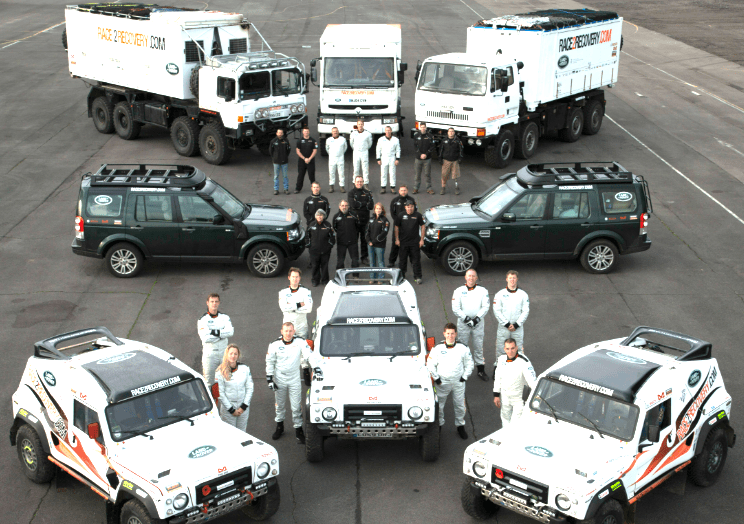
Trucks like Big Boy don’t end up as capable overland and expedition platforms by accident. The KAT1 8×8 was engineered from day one to carry serious loads over terrain that would stop most conventional trucks, and to keep doing it reliably for decades under military duty cycles. That same robustness is exactly why, decades after leaving active Bundeswehr service, this platform proved itself again — this time supporting a very different kind of mission, as part of the Race2Recovery team’s historic 2013 Dakar Rally campaign.


Leave a Reply